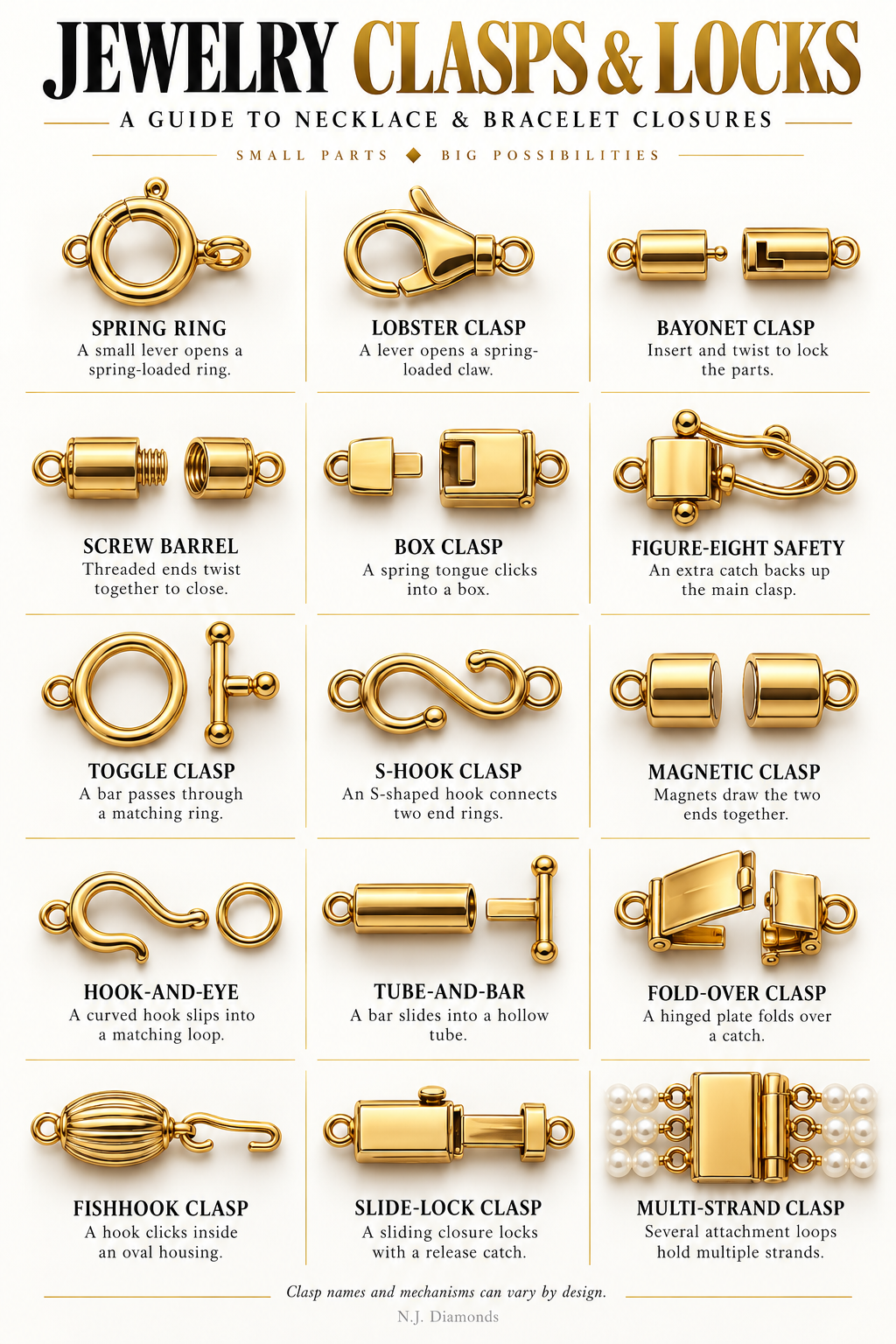
A necklace or bracelet clasp should match the piece’s weight, design, and the way you use it. The right closure should also be manageable for your hands. This illustrated guide explains common jewelry locks and the signs that a clasp needs attention.

Necklace and bracelet clasp types
Spring ring
A small lever retracts a spring-loaded section of a round clasp. It is common on lighter necklaces. The lever should move freely and the ring should close completely.
Lobster clasp
A spring-loaded claw opens with a lever and connects to an end ring. Sizes and shapes vary. The clasp and connecting rings must be appropriate for the chain’s weight.
Bayonet clasp
Matching parts insert and turn to engage a locking feature. Some designs use additional catches. Follow the mechanism of the specific clasp rather than twisting it forcefully.
Screw barrel
Two threaded ends twist together. This is also commonly called a barrel clasp; the chart combines those overlapping names. Check for worn threads and confirm the ends are fully joined.
Box clasp
A spring tongue inserts into a housing until it engages. Used on many bracelets and necklaces, a box clasp may include one or more extra safety catches.
Figure-eight safety catch
This is an auxiliary fastener, not usually the main clasp. A small hinged wire catches over a peg to add another connection. Both the main clasp and the safety need to work correctly.
Toggle clasp
A bar passes through a ring and turns across it. The bar must be long enough and the jewelry must fit appropriately; excess slack can let it turn back through the opening.
S-hook clasp
An S-shaped hook joins two end rings. The openings, metal thickness, and fit affect how well it stays connected. Repeatedly bending the hook can weaken it.
Magnetic clasp
Magnets bring two halves together. They can be easier to handle, but pulling force, jewelry weight, and any added mechanical catch matter. Do not assume magnetic attraction alone is suitable for a heavy or valuable piece.
Hook-and-eye clasp
A curved hook connects to a matching ring or loop. It offers a simple fastening with many decorative variations. Fit and the hook’s shape help keep the parts connected.
Tube-and-bar clasp
A bar slides into a matching tube. These designs are often used with multiple strands. Check the end stop or locking feature that prevents the parts from sliding apart.
Fold-over clasp
A hinged plate folds across a catch. It creates a relatively flat closure on some bracelets. Worn hinges and loose catches should be checked before further wear.
Fishhook clasp
A shaped hook engages inside a housing, often oval or decorative. Frequently seen on pearl strands, it can require a particular release motion. Avoid pulling the strand to force it open.
Slide-lock clasp
Matching parts slide together and engage a release catch. This name overlaps with other sliding closures, so examine the actual mechanism and learn how it unlocks.
Multi-strand clasp
Several attachment loops hold multiple strands in position. This describes its arrangement rather than one unique locking mechanism: a multi-strand clasp may use a box, slide, or another closure.
Choosing a clasp for your jewelry
Consider the weight of the chain and pendant, how often you wear it, and whether you can fasten it comfortably. Bracelet clasps need to be manageable with one hand. A larger clasp may be easier to operate, but it must also suit the chain and its connecting rings.
The connecting rings matter too
Even a working clasp cannot compensate for a thin, worn, or open connecting ring. Have the entire fastening inspected, including the end tabs, jump rings, hinges, and safety catches. On pearl or bead strands, the stringing and attachments need checking as well.
Frequently asked questions
Can a clasp be replaced with a different style?
Often, yes. A jeweler must check the metal, chain size, attachment points, weight, and design before recommending a replacement. Some pieces need additional work to accept a new clasp.
Which jewelry clasp is the most secure?
There is no universal winner. A well-made, correctly fitted clasp in good condition is the starting point. For some pieces, a suitable safety catch adds another connection. Choose for the actual jewelry rather than the clasp’s name alone.
What if my necklace or bracelet opens unexpectedly?
Stop wearing it and keep all parts together. A weak spring, worn tongue, damaged catch, or open connecting ring may be responsible. Have the complete piece inspected before putting it back on.
Clasp repair and replacement in Dearborn
N.J. Diamonds offers in-store jewelry repair in Dearborn. Bring your necklace or bracelet so we can inspect the closure, connections, and overall condition and discuss repair or replacement. contact N.J. Diamonds for help planning your visit.
Explore our pearl information guide and jewelry care guide. For examples of component construction, see Stuller’s jewelry findings catalog.
Return to the Jewelry Settings & Clasps Guide, or explore diamond ring settings and earring backs and settings.
Need a Necklace or Bracelet Clasp Repaired?
If a clasp sticks, slips open or feels loose, bring the piece to N.J. Diamonds in Dearborn for an in-store inspection and repair evaluation. Learn about in-store jewelry repair or call N.J. Diamonds at 313-582-7888.