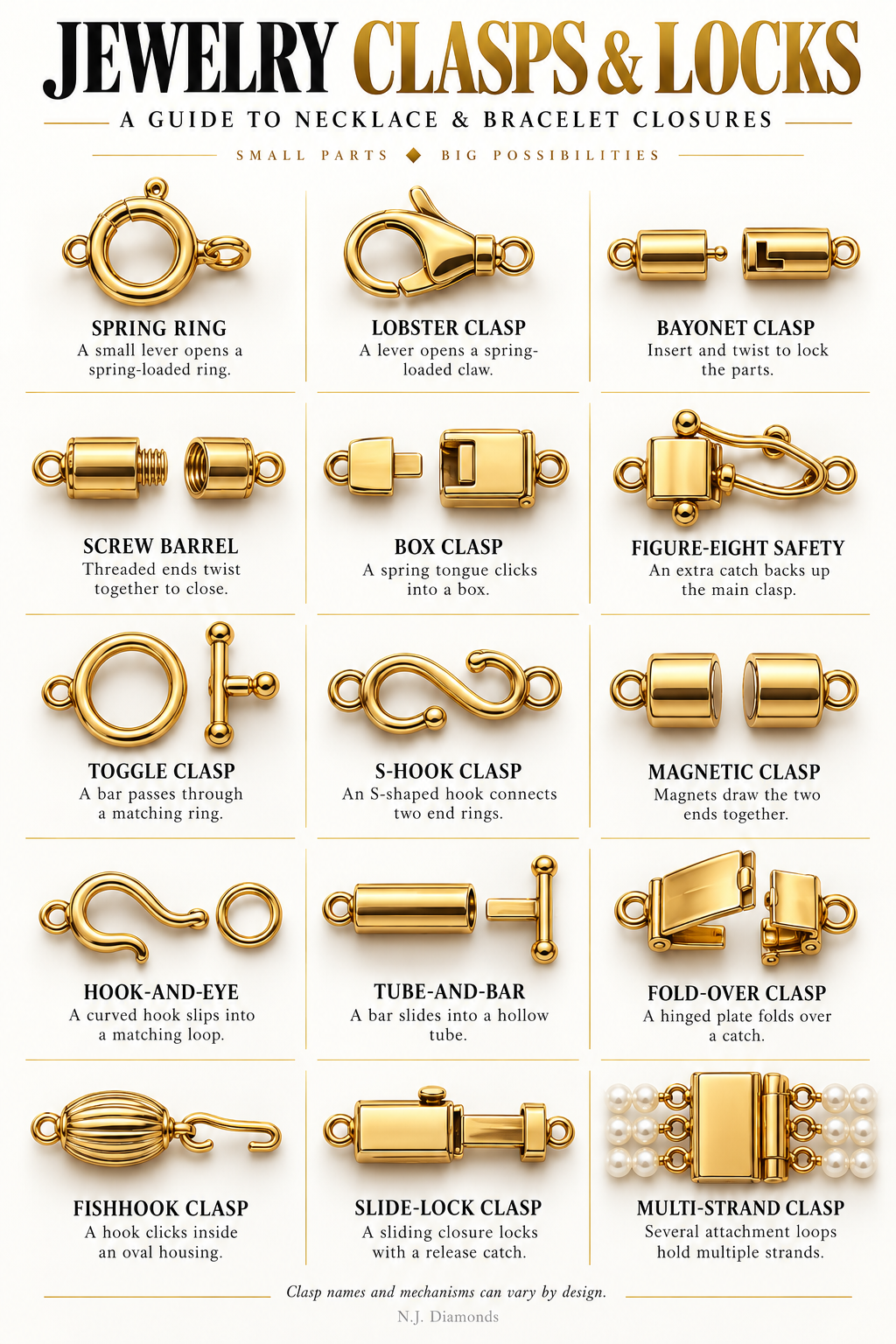
Earring backs help keep your jewelry in place, while stone settings hold the diamonds or gemstones. Understanding both makes it easier to compare comfort, support, appearance, and everyday maintenance. At N.J. Diamonds in Dearborn, we can inspect your earrings and help identify the parts they need.

Earring backs and closures explained
Push backs (friction or butterfly backs)
A friction back slides onto a smooth post and holds through tension. This familiar option is quick to use, but fit matters: a back that slides off too easily needs attention. A larger back may help support some heavier studs, provided it fits the post correctly.
Screw backs
A matching threaded back twists onto a threaded post. They take longer to fasten than push backs, but the threaded connection can help resist accidental removal. Smooth posts and screw backs are not interchangeable. Avoid forcing a back that does not turn smoothly.
Locking backs
These backs engage with a compatible notched post and use a release mechanism, often two tabs, to unlock. Designs vary by manufacturer. Learn the release action before wearing them, and check that the back has engaged.
Flat backs
A flat disc rests behind the ear. Depending on the system, the decorative front screws into the post or uses a threadless tension fit. This is a different construction from an ordinary butterfly-backed stud; all parts must belong to a compatible system.
Lever backs
A hinged lever closes behind the earwire. Common on drop earrings, lever backs create a closed loop through the piercing. Check the hinge and meeting point rather than assuming a closed lever cannot wear out.
Omega backs
A hinged loop folds against the back of the lobe to support the earring, often working with a piercing post. An omega back is not the same mechanism as a small hinged hoop. Its tension should feel supportive without pinching.
Latch backs and hinged huggies
A latch-back hoop uses a hinged post that engages a catch. Huggies are small, close-fitting hoops that commonly use a click closure. Test that the post seats correctly; a faint click alone does not prove the catch is in good condition.
French hooks and kidney wires
A French hook is an open curved earwire. A compatible stopper can help reduce slipping. Kidney wires have a longer loop that hooks into a catch, creating a closed shape. Neither should be bent repeatedly to adjust fit at home.
Threaders
A slim bar and fine chain pass through the piercing. Their light, flowing look comes without a conventional backing. Keep the chain free from tangles and follow the design’s intended wearing position.
Clip-ons
A hinged clip grips an unpierced lobe. Some use adjustable screw tension, while others use a spring clip. Comfort depends on the clip, earring weight, and fit; excessive pressure is not a sign of a better fastening.
Common earring stone settings
- Prong: Metal claws hold the stone with much of its outline visible. Prongs need inspection for wear, movement, and snagging.
- Basket: An open framework supports the gemstone beneath its edge. Basket studs can have different heights and prong counts.
- Martini: A tapered cup, commonly with three prongs, narrows toward the post. Compare how it sits on your own ear rather than choosing from its name alone.
- Bezel: A metal rim surrounds the stone’s edge for a smooth outline. The rim still needs inspection for damage or wear.
- Halo: Small stones frame a center stone. The halo adds visual spread and introduces more small settings to maintain.
- Cluster: Several gemstones form a grouped design. A cluster does not necessarily contain one large center diamond.
- Pavé: Closely arranged small diamonds are held by tiny beads of metal, creating a surface of sparkle.
- Channel: A row of stones sits between two metal rails, often along a hoop. Worn rails can affect the stability of the stones.
How to choose the right back
Try fastening and removing the earring yourself. Consider its weight, whether it tips forward, how easily you can operate the closure, and whether the back rubs against your skin. A backing should support the earring without being tightened hard against the lobe.
When to have earrings inspected
Stop wearing an earring if its back slips, its hinge is bent, its catch will not close, or a gemstone moves. Bring the complete pair and any loose parts for in-store jewelry repair in Dearborn. A new back may solve the problem, but the post or catch may also need repair.
Frequently asked questions
Are screw backs always better than push backs?
No single back is best for everyone. A properly fitted friction back may suit your needs, while another wearer may prefer a locking or threaded system. Construction, condition, compatibility, and ease of use all matter.
Can I put a locking back on my existing earrings?
Only if the post and back are compatible. Some conversions require replacement posts and a jeweler’s assessment. Bring your earrings in before buying replacement parts.
Can a heavy earring be made more comfortable?
A different support back or a repair may help, but results depend on the design and your ear. We can inspect the piece and discuss suitable options.
Get help with earrings at N.J. Diamonds
Bring your earrings to our family-owned store at Schaefer Road and Ford Road in Dearborn. We can discuss fit, worn closures, loose stones, and repair options. contact N.J. Diamonds before your visit if you have questions.
Further reading: Stuller’s earring back education and GIA’s diamond stud earring guide.
Return to the Jewelry Settings & Clasps Guide, or explore diamond ring settings and necklace and bracelet clasps.