Skip to content

Recent Posts

  • Podcast Episode: Why Buying Jewelry Still Matters Face-to-Face in the Age of AI
  • Every Ring Has a Story. Here’s One of Our Favorites.
  • PATEK PHILIPPE AQUANAUT LUCE
  • Upgrade Your Center Stone.
  • Local Secrets: Best Places to Propose in Dearborn, MI

Most Used Categories

  • Diamond engagement rings (58)
  • Custom Design (38)
  • Uncategorized (30)
  • Jewelry (15)
  • Dearborn (12)
  • jewelry repair (11)
  • Gem Stones (7)
  • Diamond Certification (5)
  • appraisal (4)
  • Diamonds (4)
Skip to content
313-582-7888
N.J. Diamonds

N.J. Diamonds

  • Services
    • Jewelry Repair
    • Jewelry Appraisals
    • Layaway
    • Why Shop With Us
  • Jewelry Blog
  • Custom Design
  • Home
  • FAQs
  • Shop
  • Pearl Guide
    • History of Pearls
    • Pearl Color & Grading
    • Pearl Grading System
    • Pearl Care
  • Diamonds
    • Diamond Certification
    • Choosing a Ring
  • Sell Gold
  • Reviews
  • Contact
  • Home
  • 2023
  • March
  • 28
  • Broken Ring Prong Repair: Signs, Process, and Prevention
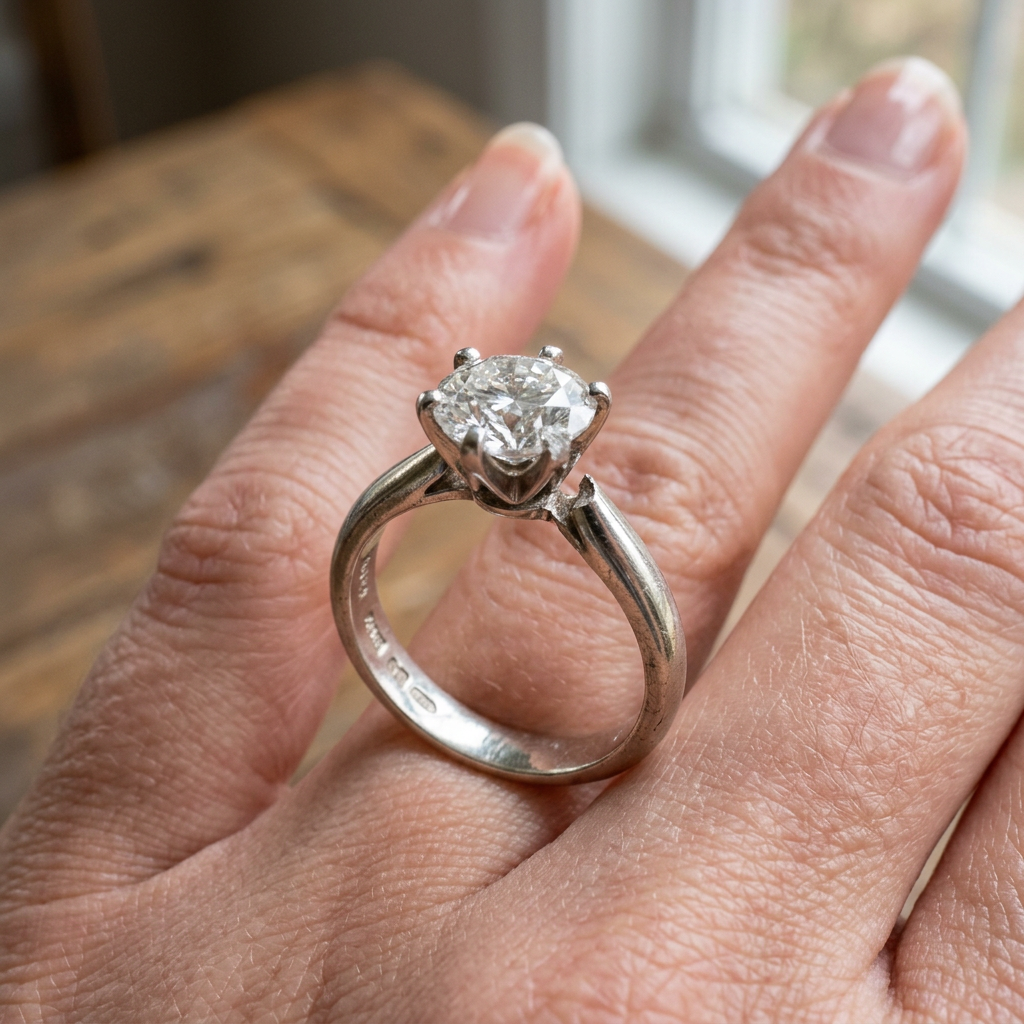
Solitaire diamond ring resting on a person’s hand

Broken Ring Prong Repair: Signs, Process, and Prevention

njdiamondsMarch 28, 2023September 30, 2026
[responsivevoice_button]

A worn, bent, or broken prong can allow a diamond or gemstone to move—or fall out completely. If a stone feels loose, a prong catches on clothing, or the setting looks uneven, stop wearing the jewelry and have it inspected promptly.

Prong repair is not a single procedure. The correct method depends on how much metal remains, the condition of the other prongs, the type of stone, and the construction of the setting.

What prongs do

Prongs are small metal supports that hold a diamond or gemstone in place. Their tips extend over the edge of the stone and create tension that keeps it secure. Normal wear gradually removes metal from those tips. A hard impact, snag, previous repair, or weakened setting can bend or break a prong more suddenly.

Warning signs of a damaged prong

  • The stone clicks, rocks, or moves when touched gently
  • A prong looks shorter, flatter, thinner, or different from the others
  • The ring repeatedly catches on fabric, hair, or gloves
  • There is a visible gap between a prong and the stone
  • The center stone appears tilted or no longer centered
  • A prong tip is missing or has a sharp edge

Do not test a loose stone by pushing it repeatedly. Place the jewelry in a small container or soft pouch and bring it to a jeweler. If a stone has already fallen out, save it separately and bring it with the piece.

Step 1: Inspect the complete setting

The jeweler examines the damaged prong, the remaining prongs, the stone, and the surrounding setting under magnification. The goal is to identify the cause, not just the most obvious symptom.

One broken prong may indicate that other prongs are also thin. The stone may be loose because the entire setting is worn, the ring has been bent, or an earlier repair no longer holds securely. Existing chips, abrasions, or inclusions near the stone’s edge may also affect how the work should be completed.

Step 2: Decide between retipping, rebuilding, or replacing

Prong retipping adds metal to a worn prong tip so it can securely cover the stone again. It may be appropriate when the lower portion of the prong remains sound.

Prong rebuilding restores a larger portion of the prong when wear extends below the tip. If several prongs are severely worn or the setting is damaged, replacing the complete head or setting may be safer and more practical than repairing each prong individually.

The jeweler should explain which option is recommended and whether nearby components also need attention.

Step 3: Protect the stone during repair

Repair methods depend on the metal, setting, and gemstone. Some diamonds tolerate procedures that would be unsafe for heat-sensitive colored gemstones or treated stones. The jeweler may remove the stone, use protective measures, or select equipment that limits heat near the setting.

This is one reason prong work should be performed by an experienced professional who can identify the materials and plan the procedure before applying heat or pressure.

Step 4: Shape, secure, and inspect the prong

After metal is restored or the component is replaced, the prong is shaped to match the setting and positioned securely over the stone. The jeweler checks that the stone does not move and that pressure is distributed appropriately among the prongs.

The repaired area is finished so it is smooth and does not snag. The jewelry may then be cleaned and polished as appropriate. Before the item is returned, the entire setting should be inspected again—not only the prong that was repaired.

How long does prong repair take?

Timing depends on the condition of the setting, the metal, the gemstone, the number of prongs involved, and whether replacement parts are needed. An accurate estimate requires an in-person inspection. N.J. Diamonds performs repairs in our Dearborn store and will explain the recommended work before proceeding.

How to reduce future prong damage

  • Remove fine jewelry before heavy work, exercise, gardening, or activities that may strike the setting.
  • Do not wear a ring that catches repeatedly; snagging may be a warning sign.
  • Store pieces separately so prongs do not scratch or catch other jewelry.
  • Have frequently worn rings inspected regularly.
  • Address loose stones and worn metal before a prong breaks completely.

Prong repair in Dearborn

N.J. Diamonds provides in-store jewelry repair in Dearborn, including prong repair, stone tightening, stone replacement, ring sizing, refinishing, and other services. Bring the jewelry—and any loose stone you still have—for an inspection.

If the jewelry was purchased from N.J. Diamonds, bring your receipt or service paperwork. Qualifying diamond jewelry may be covered by our lifetime jewelry service, subject to the applicable terms.

For everyday maintenance and storage tips, read our jewelry care guide.
Contact N.J. Diamonds About a Repair

Share this:

  • Share on Reddit (Opens in new window) Reddit
  • More
  • Share on Pinterest (Opens in new window) Pinterest
  • Share on Facebook (Opens in new window) Facebook
  • Email a link to a friend (Opens in new window) Email
  • Share on Threads (Opens in new window) Threads
  • Share on WhatsApp (Opens in new window) WhatsApp
  • Share on Bluesky (Opens in new window) Bluesky
  • Share on LinkedIn (Opens in new window) LinkedIn
  • Share on Tumblr (Opens in new window) Tumblr
  • Print (Opens in new window) Print

Like this:

Like Loading…

Related

expert jewelry repair, instore jewelry repair, jewelry repair, jewelry repair Dearborn, jewelry repair detroit, jewelry repair Michigan

Post navigation

Previous: What a GIA-Trained Diamond Professional Helps You Evaluate
Next: White Gold Diamond Rings: Rhodium, Pavé, and Care

Related Posts

Why Buying Jewelry Still Matters Face-to-Face in the Age of AI

April 14, 2026October 1, 2026 njdiamonds

Complete Ring Sizing Guide

February 4, 2026October 1, 2026 njdiamonds

Custom Emerald-Cut Diamond Engagement Ring

January 14, 2025October 1, 2026 njdiamonds

One thought on “Broken Ring Prong Repair: Signs, Process, and Prevention”

  1. Pingback: Jewelry stone setting - N.J. Diamonds

Leave a ReplyCancel reply

QR code for the N.J. Diamonds Quick Help page
Scan The Code for Our
'Quick Help Page'

Address

5601 Schaefer

Dearborn,MI 48126

☎️Phone

313-582-7888

search

Social

  • View njdia’s profile on Facebook
  • View njdiamonds’s profile on Instagram
  • View kabdelhak’s profile on YouTube

  • August 2026
  • July 2026
  • May 2026
  • April 2026
  • March 2026
  • February 2026
  • January 2026
  • December 2025
  • November 2025
  • October 2025
  • June 2025
  • April 2025
  • January 2025
  • December 2024
  • October 2024
  • September 2024
  • April 2024
  • March 2024
  • February 2024
  • January 2024
  • October 2023
  • August 2023
  • June 2023
  • April 2023
  • March 2023
  • November 2022
  • July 2022
  • June 2022
  • March 2022
  • June 2021
  • March 2020
  • February 2020
  • January 2020
  • December 2019
  • July 2019
  • April 2019
  • March 2019
  • February 2019
  • January 2019
  • November 2018
  • September 2018
  • August 2018
  • July 2018
  • June 2018
  • April 2018
  • January 2018
  • December 2017
  • October 2016
  • July 2016
  • March 2016
  • January 2016
  • December 2015
  • September 2015
  • August 2015
  • July 2015
  • June 2015
  • March 2015
  • February 2015
  • December 2014
  • November 2014
  • September 2014
  • June 2014
  • May 2014
  • April 2014
  • February 2014
  • January 2014
  • April 2013
  • March 2013
  • February 2013
  • January 2013
  • September 2012
  • August 2012
  • May 2012
  • January 2009

Why Buying Jewelry Still Matters Face-to-Face in the Age of AI - Jewels Of Information From N.J. Diamonds

N.J. Diamonds podcast explaining the reasons why it's still important to buy jewelry face-to-face, in an AI world
  1. Why Buying Jewelry Still Matters Face-to-Face in the Age of AI 03:02
  2. Why AI Can't Appraise Jewelry 19:02
  3. Why Sell Your Gold at N.J. Diamonds. 13:36
  4. Professional Ring Sizing A Good Idea 05:17
  5. Episode 3 How to Choose a Diamond Engagement Ring, Helpful Tips 00:58
  6. Episode 2 How to Choose a Diamond Engagement Ring, Helpful Tips 00:51
  7. Episode 1 How to Choose a Diamond Engagement Ring, Helpful Tips 02:16
  8. Diamond Shapes – A 10-Minute Guide to Choosing the Right One 03:26
  9. Jewelry Insurance & Appraisals: How to Protect Valuable Pieces 03:44
  10. Why Jewelry Insurance Matters: Theft, Loss & Peace of Mind 01:53
Copyright All Rights Reserved

Discover more from N.J. Diamonds

Subscribe now to keep reading and get access to the full archive.

Continue reading

%d